What Are Perfect-Fit Sleeves, and Do You Really Need Them?
|

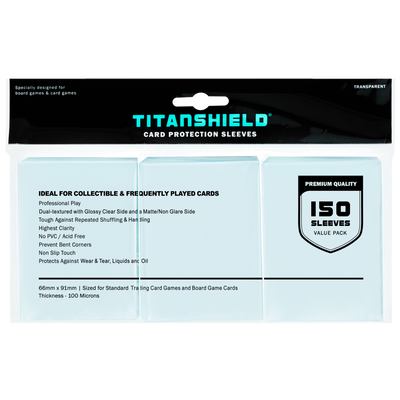


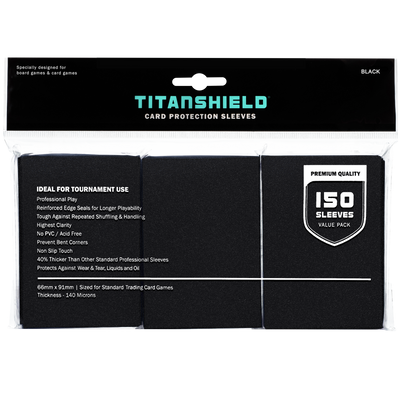








Outer sleeves do a lot of heavy lifting, preventing scratches, smoothing shuffles, and keeping deck edges clean. But they don't fully solve dust creeping in, humidity sneaking under the lip, or micro-abrasion from repeated play.
That's where inner sleeves, often called perfect-fit sleeves, come in.
In this guide, we break down what perfect-fit card sleeves are, how they differ from standard outer sleeves, and exactly how double sleeving works. We'll compare protection levels, explain top-load vs. side-load options, call out common mistakes, and help you decide when inner card sleeves are worth it for your deck, your storage, and your budget.
Perfect-fit sleeves and standard sleeves serve different purposes. Here's what you need to know.
Perfect-fit sleeves (also called inner sleeves or inner card sleeves) are thin, tight, clear sleeves designed to hug a card with a precise fit. They're sized to sit flush with standard TCG cards (Magic: The Gathering, Pokémon, etc.), typically around 63x88 mm cards, with the inner sleeve itself measuring just a hair larger than the card, often in the 64x89–90 mm range, with very tight tolerance in the 0.1–0.3 mm band depending on the brand and batch.
They're called "perfect fit" because the sleeve hugs the card with minimal excess plastic so it slides cleanly into a standard outer sleeve without bunching. You'll see terms like "tight," "thin," and "precise fit" on the pack to describe them.
Outer sleeves are thicker, more durable, and designed for play, shuffling, grip, and long-term handling. They come in different textures (matte vs. glossy), colors, and art backs. Outer sleeves also add structural support that reduces corner dings and bending during play.
Inner sleeves, by contrast, are ultra-thin and focus on creating a close seal around the card. Their role is to block dust, limit moisture exposure, and keep the card surface clean. Put simply, outer sleeves protect against external wear, while perfect-fit sleeves protect the card itself.
Double sleeving makes sense when extra protection matters, such as with foils that react to humidity, higher-value cards, decks that see heavy shuffling, or decks you carry to events. The inner sleeve acts as a barrier against dust and micro-debris, while the outer sleeve absorbs wear from play and shuffling.
Together, they reduce card movement inside the sleeve and help preserve surface quality better than a single layer alone.
Double-sleeving is a simple two-step process that adds protection without affecting how your deck plays.

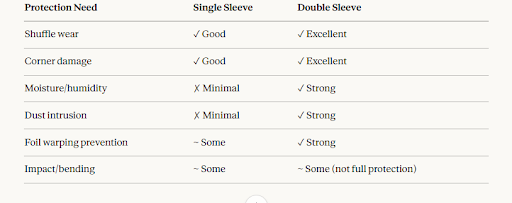
These visuals break down how different sleeve setups perform against common risks like shuffle wear, corner damage, dust, and humidity.
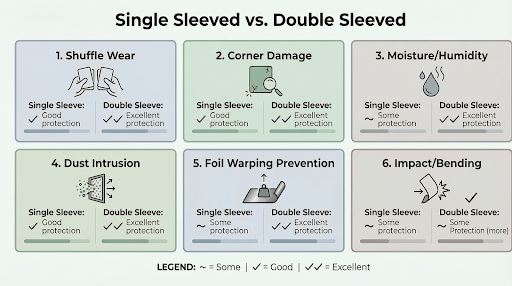
Inner sleeves come in a few different styles, each designed for a slightly different use case. The main differences come down to how the sleeve opens, how much of the card is enclosed, and whether the back is clear or tinted.
Top-load inner sleeves open on the short edge, just like most outer sleeves. They’re the most familiar option and the quickest to insert, which makes them popular for resleeving decks or testing new lists.
When double sleeving, players usually insert top-load inners upside down into the outer sleeve so the openings don’t line up, helping limit dust and moisture entry.
Side-load inner sleeves open on the long edge. By shifting the opening away from the outer sleeve opening, they create a longer path for dust and moisture to reach the card. This added sealing effect is why many collectors and competitive players prefer side-load inners for long events, travel, or higher-value decks.
The trade-off is that they can take a bit more care to insert evenly.
360-degree resealable sleeves provide all-around protection because a flap closes at the top, fully enclosing the card. This design helps block dust and humidity from every edge and is commonly used for storage or higher-value cards.
Like all inner sleeves, they’re designed to be used with an outer sleeve, not on their own.
Smoked-back inner sleeves are shaded on one side and are designed for use with light-colored standard sleeves when a fully opaque back is required for tournament play. They combine the simplicity of a top-load design with added opacity, without changing how the deck handles.
There isn’t a single “right” orientation. Most collectors focus on offsetting sleeve openings so debris and moisture don’t have a straight path to the card.
Many players orient inner and outer sleeves so the openings don't line up.
In both cases, the goal is to prevent dust and moisture from having a direct path to the card.
Collectors often prioritize maximum protection for storage. Sealable inner sleeves with four-edge protection are commonly paired with outer sleeves that have tight tolerances, offering comprehensive dust and moisture barriers.
For high-value singles, adding a rigid holder (such as a toploader or hard case) provides additional protection. Cards should be stored in a dry, cool environment with controlled humidity (ideally 45-55% relative humidity). Desiccants can help control humidity when placed in the general storage area, not directly against cards.
TitanShield offers top-loading inner sleeves in both transparent (Daylight) and smoked (Midnight) versions, plus a resealable variant for 360-degree protection.
Perfect-fit sleeves work well when they’re used correctly. Most problems come from rushing the process or pairing sleeves that weren’t meant to work together.
Perfect-fit sleeves aren’t necessary for every card, but in the right situations, they add meaningful protection for very little cost. These are the cases where inner sleeves tend to make the most sense.
Inner sleeves are often unnecessary for bulk commons, learning decks for kids, or proxies you expect to replace.
Inner sleeves have much tighter tolerances than outer sleeves, so sizing matters more. A few quick checks can help you avoid fit issues.
TitanShield Perfect-Fit Sleeves are designed to pair cleanly with TitanShield outer sleeves, making double sleeving straightforward and consistent. Product pages include sizing and compatibility details to help you choose with confidence.
Yes, if you play competitive events, shuffle frequently, collect foils, or own higher-value singles you’d hate to replace. You’ll get better surface protection, less dust intrusion, and a cleaner, more consistent deck.
No, if you’re sleeving bulk cards, teaching new players with budget decks, or replacing cards often and prioritizing speed over maximum protection.
Our take: Inner sleeves are low-cost, high-impact protection. Pair a precise-fit inner sleeve with a quality outer sleeve, and you’ll cover the most common risks seen in play and storage.
If you’re ready to upgrade, check out TitanShield Perfect-Fit Sleeves and matching outer sleeves. Choose top-load for ease or side-load for a stronger seal.
No—when they’re the right size and inserted correctly. Damage usually comes from forcing a card into a sleeve that’s too tight or catching a corner during insertion. Go slowly, support the card, and never force it. If a print run runs slightly large, switch to a roomier inner sleeve.
Most events don’t require inner sleeves, but many competitive players use them for added consistency and protection. Always check specific tournament policies. What’s typically required is opaque, uniform outer sleeves.
Yes, as long as you match sizes correctly. Standard size games like MTG and Pokémon use standard inner sleeves, while Japanese size games like Yu-Gi-Oh! require smaller inner and outer sleeves. Oversized or unusual cards need game-specific options.
A bit. Double-sleeved decks feel slightly thicker and can feel smoother, especially with matte outer sleeves. Many players prefer the added consistency, while others prefer a thinner feel. Trying a small test stack before sleeving an entire deck can help you decide.
Penny sleeves are loose, low-cost sleeves used mainly for binders or short-term protection. Perfect-fit sleeves are tight inner sleeves made to sit inside outer sleeves for play.
You can, but it’s rarely necessary. Some collectors add a perfect-fit inner sleeve, an outer sleeve, and then a character sleeve or resealable outer for storage. Keep thickness limits in mind for deck boxes and tournament rules.
They help, but they don’t eliminate it. A precise-fit inner sleeve slows humidity exchange. For stubborn curling, use controlled storage with stable temperature and desiccants, or consider rigid holders for long-term preservation.
Join TitanShield's Rewards Program:
Track your rewards easily and redeem them whenever you're ready. Earn 100 points for signing up.